Ploughman with a Horse
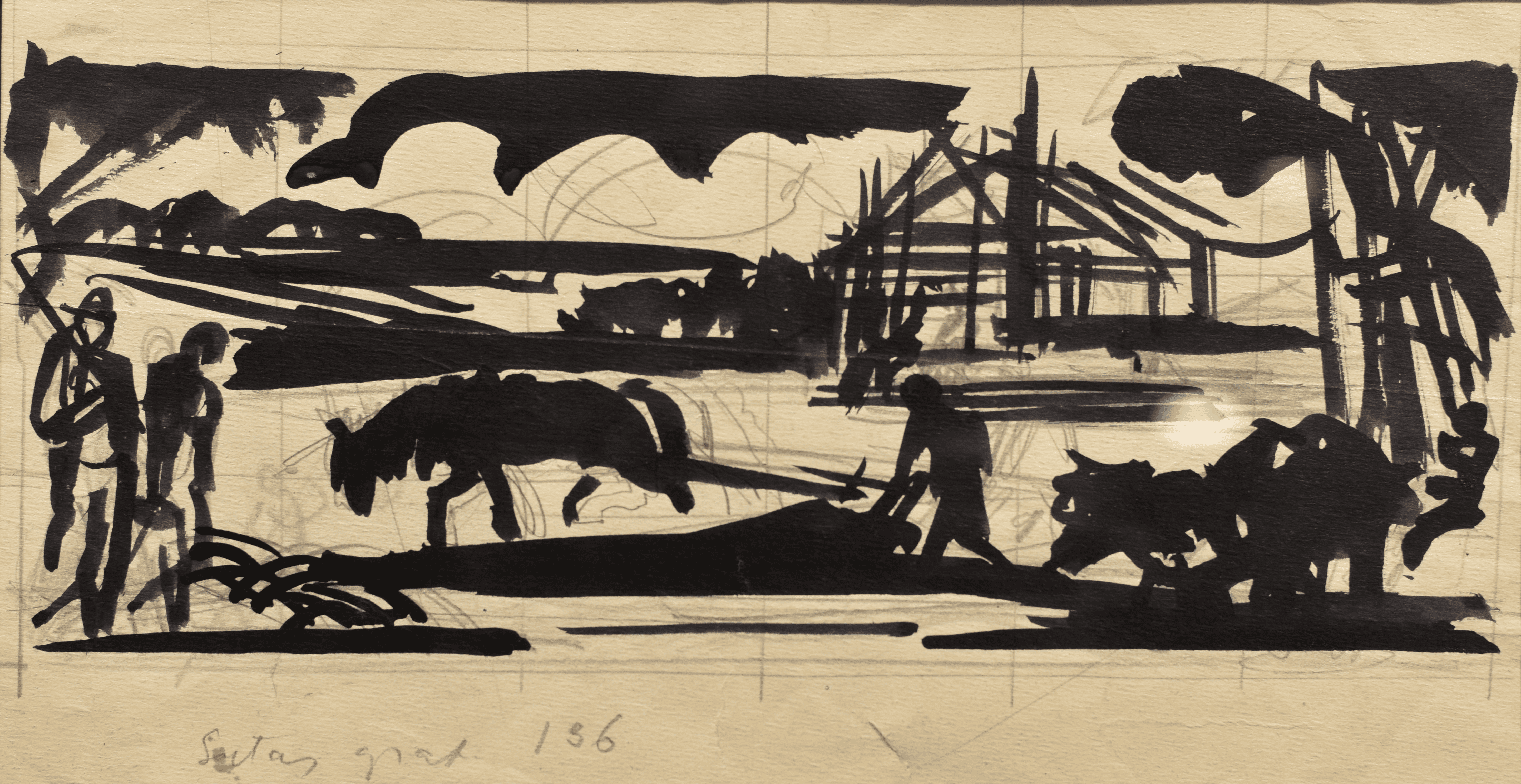
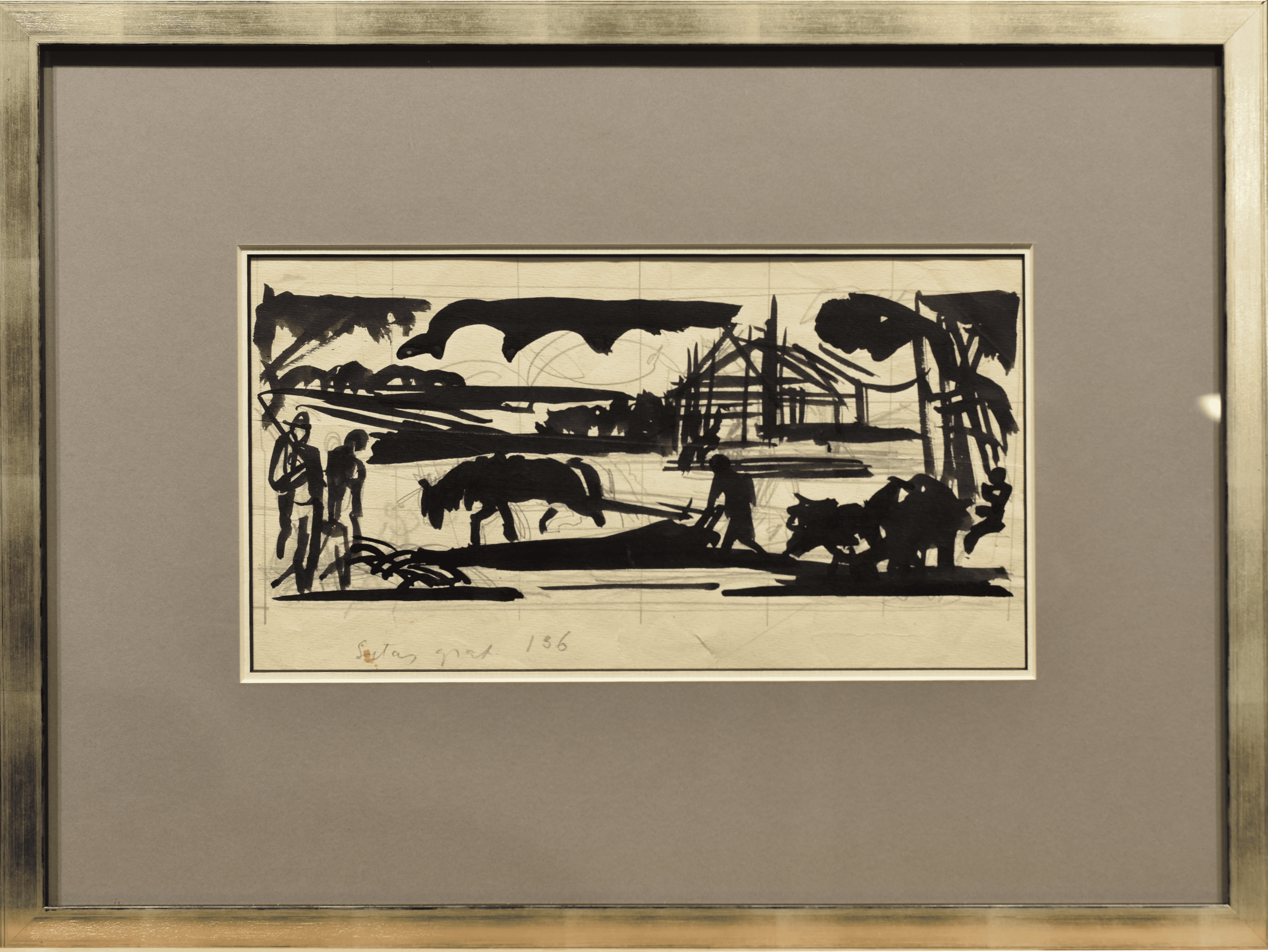
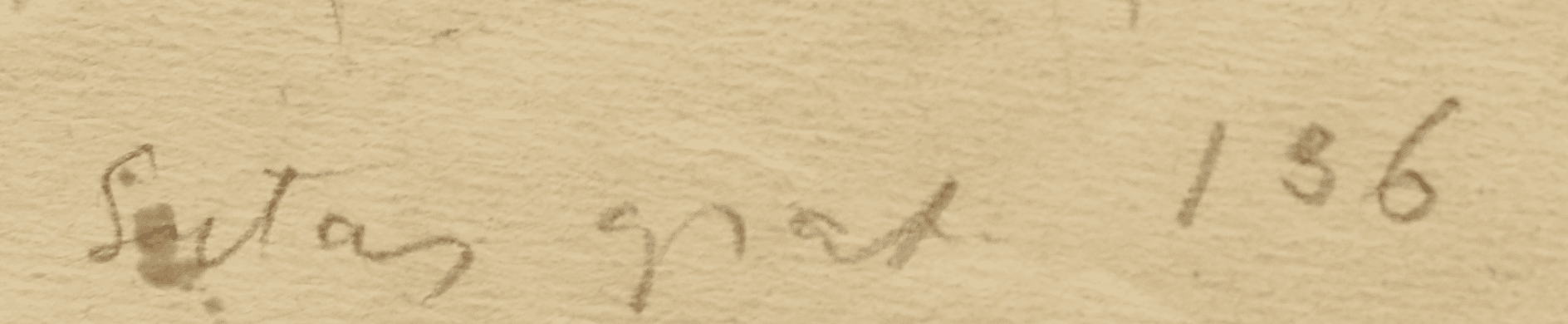
| AUTHOR | Romans Suta |
| PERIOD | 1930's |
| TECHNIQUE | Ink, pencil on paper |
| SIZE | 14x27 cm |
| PRICE | For sale from mid-2025 in The Hague |
Romans Suta
Biography
Latvian artist Romans Suta was born on April 26, 1896, near Cēsis. During his school years, he was known for his rebellious nature and showed little interest in art. He was more attracted to the adventures of sailors and, as a cabin boy, visited the largest ports in Europe. He was inspired into art by a relative who was a talented painter. In 1913, Suta began studying at the art studio of Jūlijs Madernieks (1870–1955), but stayed only a few months, finding Madernieks’s ornamental style unappealing. That same year, he enrolled at the Riga City Art School, where he studied under landscape painter Vilhelms Purvītis (1872–1945) and figurative artist Jānis Roberts Tillbergs (1880–1972).
During World War I, in 1915, Suta went to St. Petersburg, where he visited the Hermitage saw masterpieces by European classics. That same year, he joined other young artists from Riga to study at the Penza Art School in Russia. In Moscow, he also had the opportunity to see the renowned Shchukin and Morozov collections of modern art, which included works by André Derain, Pablo Picasso, and Henri Matisse.
In 1917, Suta graduated from the Penza School and went to St. Petersburg but returned to Latvia in 1919.[1] In 1922, he married artist Aleksandra Beļcova (1892–1981), and the couple moved to Paris.[2] Suta was one of the most prominent and active figures in Latvian artistic life in the 1920s and 1930s.
In 1941, during the Soviet occupation, Suta was ordered to evacuate to the Soviet Union. He lived in Moscow, then in Alma-Ata and Tbilisi, where he was arrested in 1943 and accused of falsifying bread ration cards. On July 14, 1944, he was shot. Only in 1959 did his daughter received official documents confirming his rehabilitation.[3]
Artistic style
Romans Suta is best described as a passionate, talented, and often controversial figure – one of the most active modernists in Latvian art. He worked in painting, graphic art, design, and scenography, and was also a teacher. His early style was expressive and later evolved towards Cubism. Suta was inspired by the dramatic expressiveness of El Greco, the angular figures of Derain, and the Cubist works of Picasso. He created portraits, still lifes, and figurative compositions.[4] His series of ink drawings feature military scenes, everyday life, and cityscapes. The compositions are reminiscent of Chinese calligraphy, with vivid contrasts between white and black, and brushstrokes that range from fine lines to bold, dynamic sweeps.[5] Suta’s Cubist-influenced paintings are marked by still-life aesthetics, geometric shapes, stylized figures, and minimalist portraits.
Suta was also a member of the renowned Riga Artists’ Group but later joined the Riga Graphic Artists’ Group. The group held exhibitions both in Latvia and abroad.
Interesting Facts
One of Suta’s most remarkable international achievements, and at the same time one of the brightest episodes in the history of Latvian decorative art, was the success of the Latvian porcelain brand “Baltars” between 1925 and 1928. In 1925, Suta, together with his wife Aleksandra Beļcova and graphic artist Sigismunds Vidbergs, received a bronze medal at the decorative and industrial arts exhibition in Paris for the design and painting of porcelain plates.[6]
Suta was a passionate modernist who strongly supported new theoretical trends in art against his conservative colleagues and society. He published articles in which he opposed outdated and irrelevant Russian and German artistic traditions and called for attention to be paid to innovations in French art, in which he saw the future development of the Latvian national school of painting. [7]
In 1919, the legendary café “Sukub Nr. 6” opened on Merķeļa Street across from Vērmanes Garden. Its name, coined by Suta, was inspired by two major avant-garde movements of the time – Suprematism and Cubism. The café, owned and managed by his mother, [8] quickly became a favorite meeting place for Riga’s creative intellectuals, reminiscent of the bohemian cafés of Europe’s cultural capitals.[9]
The café’s interior, designed by young modernists from the Riga Artists’ Group, stood out for its avant-garde aesthetic. True to its name, “Sukub Nr. 6” featured Cubist compositions by six young artists:: Aleksandra Beļcova, Romans Suta, Oto Skulme, Niklāvs Strunke, Valdemārs Tone, and Konrāds Ubāns.[10]
______________________________
[1] Siliņš J. Latvijas māksla 1915–1940 I. – Stokholma: Daugava, 1988.–224.–227. lpp.
[2] Pundiņa A. Publicēts 25.02.2016., Pieejams: https://arterritory.com/lv/vizuala_maksla/raksti/15744-10_neparasti_notikumi_romana_sutas_dzive (sk. 09.04.2025.)
[3] Ibid.
[4] Latvijas mākslas vēsture. – 5. sēj.: Klasiskā modernisma un tradicionālisma periods. 1915 – 1940 / Sast. E. Kļaviņš, aut. S. Pelše, A. Vanaga, V. Villerušs, K. Teivāne–Korpa, I. Martinsone, R. Rinka, M. Šuste. – Rīga: LMA Mākslas vēstures institūts; Mākslas vēstures pētījumu atbalsta fonds, 2016.–142.–143. lpp.
[5] Lamberga D. Radošais aicinājums // Romans Suta/ Sast. L. Slava – Rīga: Neputns, 2016.–306. lpp.
[6] Ibid. – 303. lpp.
[7] Ibid. – 294. lpp.
[8] Vanaga B. Sukubs – notikums latviešu glezniecībā un kafejniecībā // LNMM. – 2012. Publ.: http://www.lnmm.lv/lv/apmekle/izstades/737-sukubs-notikums-latviesu-gleznieciba-un-kafejnieciba (sk. 30.11.2019).
[9] Jevsejeva N. Romana Sutas veidotie interjeri // Romans Suta / Sast. L. Salva. – Rīga: Neputns, 2016.–363. lpp.
[10] Vanaga B. Sukubs – notikums latviešu glezniecībā un kafejniecībā // LNMM. – 2012. Publ.: http://www.lnmm.lv/lv/apmekle/izstades/737-sukubs-notikums-latviesu-gleznieciba-un-kafejnieciba (sk. 30.11.2019).